Saturday, January 10, 2015

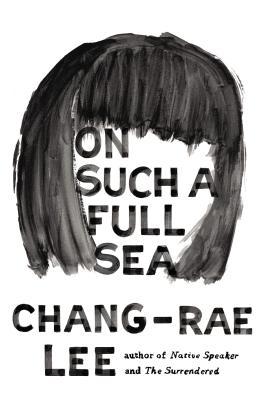
On Such a Full Sea - Chang-rae Lee

17707526

On Such a Full Sea
Written by Change-rae Lee
Hardcover, 352 pages
Published January 7th 2014 by Riverhead
ISBN 1594486107 (ISBN13: 9781594486104)
Edition language:  English
Characters:  Fan, Reg, Liwei, Oliver, Betty, Quig, Glynnis, Trish, Joseph, Loreen, Sewey, Vik, Eli, Landon, Dale, The Nicklemans

This is a strange novel expertly written.  It is a dystopian novel taking place after most of the worlds' civilizations have been wiped out due to disease and pollution.  Baltimore ("B-Mor" as it is now known) has been resettled by "New China" immigrants and society has been starkly stratified into the counties (rural poor), settlements (middle-class, highly-structured communites - B-Mor being one of them), and the Charters (the elite living in secured, gated communities).  The B-Mor community as narrator tells the story of Fan, a diver tending fish tanks who suddenly leaves after the disappearance of her boyfriend, Reg.  Although this could have easily been a highly political novel, it is primarily the story of Fan finding her way through these strata and her affect on those around her:
"What hasty preparations we make for our future.  Think of it:  it seems almost tragic, the things we're sure we ought to bring along.  We pack too heavy with what we hope we'll use, and too light of what we must.  We thus go forth misladen, ill equipped for the dawn. 
But not so our Fan.  She wasn't a prophetic one, as we know, or always ever ready, nor was she chosen, at last, to lead anyone but herself.  For at every turn, whether she bore a full satchel or one slim or nothing at all, she stood resolved, her boldness not one that simply pushed her forward but rather fixed her, solid, on the very spot she found herself.  Where you are.  Did this make her impervious?  Heroic and wise?  Not at all.  She was as subject to chance and malice as the rest of us.  She could only entertain hopes for the future.  But we know very well that there was a quality about this rootedness, which, unlike the rest of us, she never bemoaned or fought or disbelieved, that every person who met her couldn't help but recognize with a gentle trembling."  p. 301
Chang-rae Lee has given us a Greek chorus that brings us along their musings about Fan, how the community views her absence in various regards and, yes, describes some political undercurrents.  However none of this is "on the nose," and I would be hard-pressed to find a "point," or something that Lee was trying to demonstrate other than, perhaps, that everyone, no matter what class, can live a very narrow and myopic life, only needing to look up from our labors once every so often to gain perspective:

"We watch ourselves routinely brushing our teeth, or coloring the wall, or blowing off the burn from a steaming yarn of soup noodles, and for every moment there is a companion moment that elides onto it, a secret span that deepens the original's stamp.   We feel ever obliged by everyday charges and tasks.  They conscript us more and more.  We find world enough in a frame.  Until at last we take our places at the wheel, or wall, or line, having somewhere forgotten that we can look up."  p. 193
I imagine this book would be frustrating for some.  As one reviewer noted, it is more Philip Roth than Philip K. Dick.  Lee is one of those authors, however, whose writing is so well-crafted that although his story may not be full of fireworks and even drag in places, the writing pulls you along and is a joy to slow down and appreciate.  

Tuesday, June 17, 2014

The Bad Girl - Mario Vargas Llosa


The Bad Girl
Written by Mario Vargas Llosa, translated by Edith Grossman
Paperback, 276 pages
Published October 28th 2008 by Picador (first published May 30th 2006)
Original title:  Travesuras de la niña mala
ISBN 031242776X (ISBN13: 9780312427764)
Edition language:  English
Characters:  Ricardo Somocurcio, La niña mala, Paúl, Juan Barreto, Los Gravoski

I wanted to give this one star, but he's a fantastic writer. My discontent lies in that I abhor people who are door mats, fictional narrators or not. If I had to do it over again, I would have stopped when I thought I should - about 30% of the way through, and started reading "Feast of the Goat," which I hope is much better. Unfortunately, the prose and translation kept me going. I've never read "Madame Bovary," which this is a retelling. The "bad girl," the woman so filled with what some critics so ridiculously call "LIFE," (which I call manipulative narcissism), does not treat her readers by committing sweet, sweet suicide like Bovary's Emma. After the 30% mark, I told myself that anything less than a murder-suicide at the end would leave me incensed, and it has. It gets two stars and a commitment to read at least one more Llosa book; a testament to his skill. If the next book delves into this absurd sentimentality, I'll still call him a great writer, but will read no more.

Saturday, November 02, 2013

Pattern Recognition - William Gibson


Pattern Recognition (Blue Ant #1)
by William Gibson
Hardcover, 356 pages
Published February 3rd 2003 by Putnam Adult (first published 2003)
ISBN 0399149864 (ISBN13: 9780399149863)
Edition language:  English
Series:  Blue Ant #1
Characters:  Hubertus Bigend

Literary Awards:  Locus Award Nominee for Best Science Fiction Novel (2004), Arthur C. Clarke Award Nominee (2004), British Science Fiction Association Award Nominee for Best Novel (2004)

Pattern Recognition's major theme considers humans' tendency to see order out of chaos, patterns when there are none.  Other themes include branding, marketing, and consumerism, among others.  The multiple themes that require abstractions on top of abstractions left me cold and not invested.   I am empathetic to the dangers of consumerism, branding, and the post-modern marketing conceit wherein you are designated as "cool" and being a rebel for using a certain product.  Of course, if you use that product, you are possibly succumbing to the marketing and not cool or a rebel.  David Foster Wallace discussed this in his essay "E Unibus Pluram:  Television and U.S. Fiction."  DFW cites the (now almost forgotten) Sprite campaign "Image is Nothing!  Thirst is Everything!"  From the essay:  "Above all, of course, the audience is not supposed to recognize the absurdity of products being billed as distinguishing individuals from crowds in order to sell to huge crowds."  I am also simpatico with the main theme that our advanced primate evolution doesn't get us beyond seeing Mother Mary on the surface of a squash.  That's a crude way to put it - in other words, humans want order and organization in their lives and sometimes events, people, etc., simply can't be ascribed order and that's a source of anxiety.  We then find order out of randomness to help dispel this anxiety.

It's a coincidence (is it?  Or is Gibson reading my mind?!  Ahem.) that just today Gibson tweeted an article from Psychology Today about apophenia - the tendency of humans to see patterns in randomness.  After reading this, I probably shouldn't wax flippant about our advanced primate evolution - it's far better (from an evolutionary standpoint) to find patterns when there are none vs. not finding a pattern when there IS one.

Despite my affinity for these themes, I simply don't think Gibson's combination and explication of them makes a good story.  All of the underlying themes are quite interesting, but I learn more from the non-fiction material concerning these concepts and therefore find the non-fiction material also more engaging.

His prose is always very good, but I also must admit that it felt too... precious(?) at times - "The spent match makes a tiny ceramic sound when he drops it into the ashtray. "

Perhaps the book is too smart for me and I just don't "get" it.  In any event, moving on, and debating whether or not I want to read the other books in the "Blue Ant" or "Bigend" series.


Wednesday, September 18, 2013

Upon a Dying Lady - W.B. Yeats

I am on vacation and I promised myself I would get reacquainted with poetry and W.B. Yeats in particular. I'd like to share an explication of his collection of poems entitled "Upon a Dying Lady."

UPON A DYING LADY

I

HER COURTESY

WITH the old kindness, the old distinguished grace
She lies, her lovely piteous head amid dull red hair
Propped upon pillows, rouge on the pallor of her face.
She would not have us sad because she is lying there,
And when she meets our gaze her eyes are laughter-lit,
Her speech a wicked tale that we may vie with her
Matching our broken-hearted wit against her wit,
Thinking of saints and of Petronius Arbiter.

II

CERTAIN ARTISTS BRING HER DOLLS AND DRAWINGS

Bring where our Beauty lies
A new modelled doll, or drawing, 
With a friend's or an enemy's
Features, or maybe showing
Her features when a tress
Of dull red hair was flowing
Over some silken dress
Cut in the Turkish fashion,
Or it may be like a boy's.
We have given the world our passion,
We have naught for death but toys.

III

SHE TURNS THE DOLLS' FACES TO THE WALL

Because to-day is some religious festival
They had a priest say Mass, and even the Japanese,
Heel up and weight on toe, must face the wall
--Pedant in passion, learned in old courtesies,
Vehement and witty she had seemed--; the Venetian lady
Who had seemed to glide to some intrigue in her red shoes,
Her domino, her panniered skirt copied from Longhi;
The meditative critic; all are on their toes,
Even our Beauty with her Turkish trousers on.
Because the priest must have like every dog his day
Or keep us all awake with baying at the moon,
We and our dolls being but the world were best away.

IV

THE END OF DAY

She is playing like a child
And penance is the play,
Fantastical and wild
Because the end of day
Shows her that some one soon
Will come from the house, and say--
Though play is but half-done--
"Come in and leave the play."

V

HER RACE

She has not grown uncivil
As narrow natures would
And called the pleasures evil
Happier days thought good;
She knows herself a woman
No red and white of a face,
Or rank, raised from a common
Unreckonable race;
And how should her heart fail her
Or sickness break her will
With her dead brother's valour
For an example still.

VI

HER COURAGE

When her soul flies to the predestined dancing-place
(I have no speech but symbol, the pagan speech I made
Amid the dreams of youth) let her come face to face,
Amid that first astonishment, with Grania's shade
All but the terrors of the woodland flight forgot
That made her Dermuid dear, and some old cardinal
Pacing with half-closed eyelids in a sunny spot
Who had murmured of Giorgione at his latest breath--
Aye and Achilles, Timor, Babar, Barhaim all
Who have lived in joy and laughed into the face of Death.

VII

HER FRIENDS BRING HER A CHRISTMAS TREE

Pardon great enemy,
Without an angry thought
We've carried in our tree,
And here and there have bought
Till all the boughs are gay,
And she may look from the bed
On pretty things that may
Please a fantastic head.
Give her a little grace,
What if a laughing eye
Have looked into your face--
It is about to die.


Originally published in Yeats’s 1917 collection “The Wild Swans at Coole,” The collection of poems “Upon a Dying Lady” visits the larger collection’s theme of life, love, and death – an elegy to a young woman whose life dramatizes the tension between passion, play, and responsibility (mainly vis a vis religion).  An adoring, admiration-filled acquaintance is the speaker of this poem who is visiting a dying, unnamed woman.  We know from Yeats’s letters that the woman in question is Mabel Beardsley, a young actress and friend whose long, brave battle with cancer gave Yeats a muse through which to examine bravery and mortality.  (Unterecker, pp. 145-146). 

In the first poem, “Her Courtesy,” the poet describes her kindness, her grace and her “lovely, piteous head.”   The poet’s admiration of the woman’s strength comes from her strength in the face of her mortality.  Her “laughter-lit” eyes, her “wicked” tale, contrast with the poet’s “broken-hearted wit.”  This character brings about the last line, echoing both the saints and the mischief of Petronius Arbiter, a compatriot of the Roman emperor Nero, purported to write “The Satyricon” and a teller of ribald tales. (Johanides)

The second poem, “Certain Artists Bring Her Dolls and Drawings,” relates how the young lady receives gifts of dolls and drawings, and the last lines “We have given the world our passion / We have naught for death but toys” conjures a darkly humorous moral of spending all of our passion in life so that we only have our insignificant trinkets to offer when Death appears.

The third poem, “She Turns The Dolls´ Faces To The Wall” conveys a satirical view of religion as even inanimate objects must show respect during mass and describes the priest as “baying at the moon,” contrasting this with the playful nature of Longhi, a Venetian artist who had a number of paintings depicting Venetians at play.[i]  Yeats echoes this vision of Venice throughout, especially costume and galas, the “domino”[ii] (the half-mask worn over the eyes), the “red shoes,” etc., the last line culminating in the wistful notion of taking refuge in play, leaving the world behind.

The fourth poem, “The End of the Day,” continues the play motif, but darkens when Death, the parent, calls the child in. 

The fifth poem “Her Race” further exemplifies the poet’s admiration of the young lady.  She does not decry the pleasures she’s experienced and uses her example of her brother to be strong in the face of Death.   In Yeats’s letters, he writes that Mabel describes her brother as being the one to introduce her to Heaven, although “they might not appreciate the introduction” and that he had a “passion for reality.”  (Unterecker,  p. 146).

The sixth poem “Her Courage” wishes that when young lady gets to her “pre-destined dancing place” she is visited by various persons of myth and history who exemplify her character.  These include Grania[iii], a passionate heroine from Irish mythology, and Diarmuid[iv] (Grania’s lover).  There is a priest who with “half-closed eyelids in a sunny spot” is murmuring about the Italian painter Giorgione[v], whose paintings were notably void of devotional themes.   This image contrasts with the earlier priest baying at the moon and the backs of dolls – rather, this is a man getting beyond his strict devotion to appreciate the tactile and the beauty of art unrestrained.  There is Achilles, the famous Greek warrior, Timor and Babar, fearless Mongolian leaders, and Bahram, a hunter in “The Rubáiyát of Omar Khayyám” These and others are “all who have lived in joy and laughed into the face of Death.”[vi]  (Unterecker, p. 146), (Khayyám and Fitzgerald, p. 251)

The seventh and final poem, “Her Friends Bring Her a Christmas Tree” begins by asking Death a pardon so that the poet and his friends can bring in a Christmas tree to please her and then asks Death to give her a little grace as she looks him in the face with her laughing eyes.

Yeats contains multitudes.  He has a bright spirit, a kind heart, a sharp wit and a keen intellect.  I enjoyed reading this poem and learning its references and history immensely.


Bibliography

Johanides, Milton. "Poetry analysis: Upon a Dying Lady, by William Butler Yeats." Helium.com 13 January 2012. www. http://www.helium.com/items/2279739-upon-a-dying-lady-yeats-critique
Khayyám, Omar and Edward Fitzgerald. Edward FitzGerald, Rubáiyát of Omar Khayyám: A Critical Edition. Ed. Christopher Decker. University of Virginia Press, 1997. Google Books. http://books.google.com/books?id=nihvj8fPztEC&dq=bahrain+rubaiyat&source=gbs_navlinks_s
Unterecker, John Eugene. A Reader's Guide to William Butler Yeats. Syracuse University Press, 1996. Google Books. http://books.google.com/books/about/A_Reader_s_Guide_to_William_Butler_Yeats.html?id=D8Yl3rr5xZwC


Monday, September 16, 2013

Jonathan Franzen on Karl Kraus

Jonathan Franzen, unafraid to post his own unpopular opinions, wants to bring light to Karl Kraus - a "fin de siècle" thinker, who was also wrote challenging, abrasive opinions about culture and was read by many prominent thinkers at the time. Both writers reflect my own growing fear about modern culture, especially the dark side of the internet.

An excerpt from the article follows - find the entire article here.

In his (Kraus's) essay "Apocalypse", a few years earlier, he'd written: "Culture can't catch its breath, and in the end a dead humanity lies next to its works, whose invention cost us so much of our intellect that we had none left to put them to use. We were complicated enough to build machines and too primitive to make them serve us." To me the most impressive thing about Kraus as a thinker may be how early and clearly he recognised the divergence of technological progress from moral and spiritual progress. A succeeding century of the former, involving scientific advances that would have seemed miraculous not long ago, has resulted in high-resolution smartphone videos of dudes dropping Mentos into litre bottles of Diet Pepsi and shouting "Whoa!"

A book of Kraus's essays, "The Kraus Project," edited by Franzen, is due out October 1.

Saturday, August 31, 2013

The River Swimmer - Jim Harrison

This book contains two novellas - one concerning an aging art professor and the other explores a gifted, young swimmer whose wisdom belies his years.

Harrison seems to use his characters as proxies of himself lately and these two novellas are no different - lustful outdoors-men who enjoy their whiskey, wine and food. At first I was scared that this his writing was beginning to become a parody of itself, but even if these tropes show up often, his insights and prose lay the parody notion to rest. Mr. Harrison, please keep writing about struggles of the heart, the mysteries of life and if whiskey, women and French cheeses seem to often appear in the mix, so be it. What a ridiculous complaint, eh?

Saturday, August 17, 2013

No Country for Old Men - Cormac McCarthy

Although the "Aw shucks, this country is going to hell" theme got on my nerves by the end, McCarthy's prose is amazing:

"The raw rock mountains shadowed in the late sun and to the east the shimmering abscissa of the desert plains under a sky where raincurtains hung dark as soot all along the quadrant."1

It took me a couple of rereads and a dictionary to parse that sentence. It's impressive.

The plot shouldn't be examined too closely - let the prose and a villain for the ages pull you through this.

1Mccarthy, Cormac (2007-11-29). No Country for Old Men (Vintage International) (Kindle Locations 517-518). Knopf Doubleday Publishing Group. Kindle Edition.

Reamde - Neal Stephenson

There must have been SOMETHING for me to finish a 1000+ page book, but this was exposition upon exposition. I cannot think of anything more boring than reading hundreds of pages concerning the economy of a FICTITIOUS MMORPG.
I'm an action nut, so I kept going, but shame on me.

Saturday, July 20, 2013

The Flamethrowers - Rachel Kushner

Chapter 3, in its entirety, is a study in beautiful language. I dug the motorcycle parts. I didn't dig the art parts. I dig her obvious love of language. I didn't dig her obvious overuse of language.

This is another "flawed genius" book. It's worth the pretense and, let's be honest, I think it's impossible for any artist not to be ostentatious as part of the process of creation. Two of William Blake's proverbs of hell come to mind: "You never know what is enough unless you know what is more than enough, " and "Prudence is a rich ugly old maid courted by Incapacity."

Albeit the pretentiousness, Kushner is a tremendous talent whom I hope can replicate what amount of language is "just enough" more often.

Monday, June 17, 2013

The Steel Remains - Richard K. Morgan

Richard K. Morgan wrote, possibly, my favorite sci-fi novel, "Altered Carbon." This is his first fantasy novel. Morgan has ignored many fantasy conventions with "The Steel Remains." There is a gay protagonist, aliens, and gay sex between the protagonist and the alien. The sex is told with the usual Morgan detail, that is, the sex sections are basically pornography. It's a very brave route and I applaud Morgan for the bravery, but it also seemed ridiculous - more on this shortly.

It has the other Morgan touches as well - excellent descriptions, prose, structure, and a taste for the ultra-violent.

There's a mind-bending time-space continuum portion that's a little over-the-top and goofy, but Morgan again uses a deft writing hand to navigate his readers through it.

Ultimately, my final take is that this is, in many ways, an amazing book, but, yet, I simply didn't enjoy reading it that much. Ringil (the gay protagonist) is something of an ass and you could argue that it's because he's had to be. All the characters seemed a little thin and I can't completely get past the notion that he's breaking the rules of fantasy for the sake of breaking the rules. The homosexual/alien dynamic strikes me as goofy even though Morgan executes it well, but only in retrospect. Upon the initial reading, it was a you-have-to-be-shitting-me moment. It's difficult to discuss the homosexual component - it certainly strikes me as odd, gratuitous and, at first, seemed to detract from the story and seem somewhat implausible. However, in retrospect, it's a better book than my initial impression. Morgan provides answers and motives. I just wish that Morgan would have written a novel that brings in its readers as well as Ringil crosses swords.

Monday, June 03, 2013

A Visit from the Goon Squad - Jennifer Egan

I'm already conflicted by this book, so I'm taking the lazy way out and merely listing my reactions as I posted them on Goodreads:

"This seems too clever for its own good. I kind of hate it so far. I'm sticking with it, but find the encapsulation of a subject's life in a single paragraph annoying. Is this just one stream of consciousness intertwining characters together in what amounts to short stories? Fine, if it resonates." 05/28 page 85

"And just that quickly... I've been horn-swaggled into thinking this might be without merit. The "X's and O's" chapter - a (the?) Scotty chapter - is amazing. Jonathan Franzen said (or wrote - don't have the original source) that a writer should write in the third person unless a distinctive first-person voice offers itself. I hoped that these short stories intertwined would resonate and Scotty's first-person narration of meeting an old friend, his isolation, etc., certainly has resonated with me."

This is a deeply-flawed work of genius. I rank Egan in a club with Paul Thomas Anderson, David Foster Wallace, and Lev Grossman (to name a few).

In all of these, my admittedly amateur critique sees brilliance in prose indelibly marred by something else- too clever technique (Wallace, Egan), overlong (Anderson) or derivative (Grossman).

All of these artists have equally indelible gifts, all of them having the prose and insight to quickly establish a human condition.

I'm so confused I don't know whether to rate this a 1 star or 5 star. So, 3.

Friday, May 24, 2013

Every Love Story Is a Ghost Story: A Life of David Foster Wallace - D.T. Max

D.T. Max has written a level-headed biography of DFW. The navel-gazing into the theory and meaning of DFW's works vis-à-vis his mental state strikes me as pretentious. However, I admit to being something of a simpleton when it comes to literary theory. It's probably just over my head.

Taken as a whole, Max's writing is compelling and highlights include snippets of DFW's correspondence with Don DeLillo and Jonathan Franzen.

Max's neutral approach and mostly straightforward writing failed him at probably the most crucial part - the end. In fact, the last paragraph and last sentence specifically, pisses me off:

"The story of 'David Wallace' was now first. In his final hours, he had tidied up the manuscript so that his wife could find it. Below it, around it, inside his two computers, on old floppy disks in his drawers were hundreds of other pages— drafts, character sketches, notes to himself, fragments that had evaded his attempt to integrate them into the novel over the past decade. This was his effort to show the world what it was to be 'a fucking human being.' He had never completed it to his satisfaction. This was not an ending anyone would have wanted for him, but it was the one he had chosen."

For fuck's sake, man. You couldn't pass on that last sentence when it popped in your head? The sentiment is fine, but you couldn't pass on that little trick of a phrase after spending a significant amount of time discussing Wallace's wish for genuine, "single-entendre" writing?

Read this, anyhow.

Monday, May 20, 2013

I Married a Communist - Phlip Roth

This is the first book I've read penned by Philip Roth, and my expectations were off-kilter. I see his genius with the pen, but man, oh, man this book was a slog to get through. In my eyes, this book is summed up well in a couple of brilliant paragraphs:

"There was one song she (ed. Lorraine, Murray's daughter) especially loved. It was beautiful, too, a stirring, mournful, hymnlike folksong called 'Dubinushka,' a simple song sung with a balalaika in the background. The words to 'Dubinushka' were printed in English on the inside of the album cover, and she learned them by heart and went around the house singing them for months.

Many songs I have heard in my native land - Songs of joy and sorrow But one of them was deeply engraved in my memory: It's the song of the common worker.

That was the solo part. But what she liked best to sing was the choral refrain. Because it had 'heave-ho' in it.

Ekh, lift up the cudgel, Heave-ho! Pull harder together, Heave-ho!"

… In the dark we listened, though now neither I to him nor her to me but both of us to "Dubinushka." It was just as Murray had described it: beautiful, a stirring, mournful, hymnlike folksong. Except for the crackle off the worn surface of the old record - a cyclical sound not unlike some familiar, nocturnal night noise of the summer countryside - the song seemed to be traveling to us from a remote historical past. It wasn't at all like lying on my deck listening to the radio to the Saturday night concerts live from Tanglewood. "Heave-ho! Heave-ho!" was out of a distant place and time, a spectral residue of those rapturous revolutionary days when everyone craving for change programmatically, naively - madly, unforgivably - underestimates how mankind mangles its noblest ideas and turns them into tragic farce. Heave-ho! Heave-ho! As though human wiliness, weakness, stupidity, and corruption didn't stand a chance against the collective, against the might of the people pulling together to renew their lives and abolish injustice. Heave-ho.

I didn't appreciate 320 pages of two characters talking about a third character. Mamet once wrote in a memo to screenwriters that "ANY TIME TWO CHARACTERS ARE TALKING ABOUT A THIRD, THE SCENE IS A CROCK OF SHIT." To be fair, Mamet was referring to TV drama, and not a novel, but this ENTIRE NOVEL IS TWO CHARACTERS TALKING ABOUT A THIRD, and it caused the same boredom in me that Mamet warns about.

Tuesday, October 02, 2012

The Master

Once again, Paul Thomas Anderson has made a flawed work of genius. Freddie Quell is a WWII vet, psychologically damaged before he even went to war and currently spends his time drinking solvents and cleaners during and between various jobs. He stumbles upon "the master's" (Lancaster Dodd's) vessel before it embarks upon a seafaring, brain-washing voy-ahj. Lancaster Dodd is to L. Ron Hubbard as Charles Foster Kane is to William Randolph Hearst.

"The Master" has a great premise, brilliant cinematography, and acting performances for the ages. It also has surprisingly good pacing for a movie that my friend Shawn accurately described as having "no plot, I mean NO plot."

The flaw is that I don't ever get a connection with the characters. I never truly felt why Lancaster Dodd and Freddie Quell need each other. I suppose Freddie seems to benefit by having a direction for awhile, but the whole thing is so ambiguous that it's hard to tell.

Quell, played by Joaquin Phoenix, and Dodd, played by Philip Seymour Hoffman, have an early scene for the ages wherein Dodd engages Quell in "informal processing," which involves an interrogation apparently designed to confront the person being processed rapidly and quickly before delusion can set in so that the subject comes to some truth about him/herself. Amy Adams also gives an amazing performance as Dodd's wife, Peggy.

This movie's strong points make it hard to fault this movie. My brain was excited at the end, yet this was betrayed by the involuntary shoulder shrug that occurred as I relieved myself in the theater bathroom, focusing on one point in the urinal.

You should see this movie. 99% of the reason is for the "informal processing scene" and 1% is to get that toilet reference (do it for me).

IMDB page

Thursday, July 26, 2012

Norwood - Charles Portis

I was anxious to read Portis after seeing "True Grit" (still need to read it), and reading about his facility with Southern dialogue.

That being said, coming off the heels of the breakneck pace of "Leviathan Wakes" and my consequent breakneck reading pace, I read this book too fast and missed (some of) the devil in the details, Portis's dialog and prose.

I didn't miss it all and it made for a nice weekend read.

"I wish Sammy Ortega was here," said Miss Phillips. "He'd break your arm."

"I'd like to see him try it," said Norwood.

"I was talking to Fring, I wasn't talking to you," she said. "But he'd get you too if he felt like it, you bigmouth country son of a bitch. He'd kick your ass into the middle of next week."

"I'd like to see him try it."

"You just got through saying that. Don't keep saying the same thing over and over again. Don't you have good sense?"

"You said you was talking to him the first time."

"You peckerwood."

Leviathan Wakes - James S.A. Corey

Even though this is a hefty tome at over 600 pages, "Leviathan Wakes" non-stop action makes the reading easy. This "kick-ass space opera" as George R.R. Martin's blurb refers to it is, indeed, a kick-ass space opera. Penned by James S.A. Corey, it is a rollicking good time with noir and horror elements thrown in. James S.A. Corey is the pen name for the collaboration of the authors Daniel Abraham and Ty Franck.

On my Goodreads review, I deliberately didn't talk about it much, but for my own edification and record-keeping, I'd like to put my thoughts down here. If you're going to read it, I'd suggest you stop reading now as the book is best enjoyed with no prior conceptions.

The book is well-paced throughout, but the second half of the book contained elements that rang a little false to me, especially the notion of using the Mormons' generation ship to push the infected space station into the sun.

An additional question I ponder is if this would have been a better book if the stakes hadn't been the highest (survival of humanity)? I understand that these stakes are a trope of the space opera sub-genre, but I wonder if a better book would have been written had the stakes been dialed down somewhat to allow less desperate measures to be used for resolution? Those desperate measures took me out of the story somewhat. Drama exists in many forms and levels - the very survival of humanity doesn't have to be at stake to create it.

My criticisms are minor and almost seem disingenuous given how much fun this tale gives to the reader. I look forward to reading the second of three in the series, "Caliban's War."

Wednesday, June 13, 2012

The Sisters Brothers, - Patrick deWitt

"... 'Now you dance, chink!' With these words, the boy began dancing wildly and without grace, looking much like someone forced to stand barefoot over hot coals. It was an ugly thing to witness, and if I had not before made my decision about Mayfield, the matter was now settled in my mind." - Eli Sisters
After reading and greatly enjoying this book, it's finally come to me that I’m a fan of the Western. It surprises me, although I’m doing some head-smacking at my lateness in the realization. Westerns, whether in book or film form, bored me when I was younger. I think the drab landscape, lack of technology and overused tropes kept me away. What I think has brought me back is the prose in both Portis’ book “True Grit” and the recently remade film, as well as the excellent HBO series “Deadwood.” I have a fondness for this style of prose - characterized by formal use of language, sometimes punctuated by expletives and employing minimal use of contractions. DeWitt continues this style to magnificent effect.

This is a tale of Eli and Charlie Sisters: two brothers who are killers for hire. They encounter many characters and events on their journey. This might be called an anti-Western for its satirical moments, somewhat rambling plot and overall bleak outlook on civilization. The plot is secondary in my view, although it isn’t horrible. The joy of reading this book is the musings of the narrator, Eli Sisters as well as other characters in the book.

I’ve collected a few that follow.

Regarding gold-rush era San Francisco:

"’You must understand, gentlemen, that the tradition of thrift and sensible spending has all but vanished here. For example, when I arrived last time from working my claim I had a sizeable sack of gold dust, and though I knew it was lunacy I decided to sit down and have a large dinner in the most expensive restaurant I could find... and for this repast, which would have put me back perhaps half a dollar in my hometown, I paid the sum of thirty dollars in cash’

Charlie was disgusted. ‘Only a moron would pay that.’

‘I agree,’ said the man. ‘One hundred percent I agree. And I am happy to welcome you to a town peopled in morons exclusively. I hope that your transformation to moron is not an unpleasant experience.’”


“‘Yesterday I saw a man leap from the roof of the Orient Hotel, laughing all the way to the ground, upon which he fairly exploded. He was drunk, they say, but I had seen him sober shortly before this. There is a feeling here, which if it gets you, will envenom your very center. It is a madness of possibilities. That leaping man’s final act was the embodiment of the collective mind of San Francisco. I understand it completely. I had a strong desire to applaud, if you want to know the truth.’”

This is the most I’ve enjoyed a book in a long time. A blurb refers to it as “cowboy noir,” which is apt. It is much-appreciated storytelling enlivened by simple, straightforward, writing craft.

Body count:

16 men shot
2 men poisoned
1 man drowned
1 man suicide by axe
2 bears
4 horses
1 dog
9 beavers

Saturday, June 09, 2012

Prometheus

There are a few things good about this movie, unfortunately they don’t make up for the movie being, well, stupid. If you’re reading this as a part of your decision process to see it in the theater, don't. Overall, the movie misses its mark. Read on if you don’t mind spoilers or have already seen the film.

Good things about the movie are Michael Fassbender’s performance and the cinematography and special effects.

So much for the good aspects.

The script for this movie simply makes no sense. During the opening scene, we are introduced to two archaeologists in love, Elizabeth and Charlie, who find a cave painting depicting giant humanoids pointing out to a star cluster. They connect this to other primitive cultures' depictions of similar humanoids pointing to a similar star cluster (5 stars).

Somehow that’s interpreted as an invitation to come find humanity’s creators (the “engineers”)? They rustle up some funding from Weyland-Yutani corporation - a TRILLION dollars, according to Meredith Vickers, played by Charlize Theron, the chosen Weyland representative. Vickers and crew, aboard the spaceship Prometheus, head to a distant moon. How they were able to narrow down a cluster of 5 heavenly bodies to a single spot in the universe seems ridiculous, but, okay, it moves the story forward.

Once aboard the ship, it seems that Meredith Vickers is in charge, but then a hologram of Peter Weyland, the company founder, instructs them that the archaeologists in love are in charge. Plus we have the captain of the ship, played by Idris Elba, who also seems to have some autonomy. A trillion-dollar expedition where no one is quite certain who’s boss?

Upon arrival at the moon, this lack of leadership is evident as they run off without, seemingly, forming a plan. Cap’n Janek warns them they only have 6 hours of daylight left, but damn the torpedos (!), the archaeologists in love are not going to wait to meet their makers! Ahem.

Other characters on this exploratory mission include a geologist and a biologist. These guys are the best part of the movie. Upon entering a cave complex, the geologist sets out robotic drones that quickly map the subterranean caverns and tunnels. The geologist skillfully leads them through the caverns whereupon they find dead engineers. The geologist and the biologist freak out at this. They knew there was the prospect of finding LIVE engineers and I guess they assumed that they would be friendly, but the fact that they were massacred, 2000 YEARS AGO, is freaking them out. So they split. Not only do they split, but THEY GET LOST. EVEN THOUGH THE ENTIRE PLACE IS MAPPED WITH THE GEOLOGIST’S DRONES AND THEY’RE IN CONSTANT COMMUNICATION WITH CAP’N JANEK. A storm comes and these two are forced to spend the night in the cave. During the night they run into a phallic, alien, snake-like creature. They're trapped underground, millions of miles from home and they're encountering their first live alien which acts just like a king cobra. What does the highly qualified BIOLOGIST, hired to go on a TRILLION-DOLLAR MISSION DO? HE TREATS IT LIKE A GERBIL FOR FUCK’S SAKE, COOING AT IT AND OFFERING HIS HAND TO IT, WHEREUPON ANIMALS ATTACK AND HE AND THE HANSEL-AND-GRETEL GEOLOGIST RIGHTLY SUFFER A HORRIBLE DEATH.

I almost applauded.

I’ll just (try and) stop here. They have an automated surgery pod that is for men only because apparently having breasts and a vagina complicates a pod capable of robotic surgery. The archaeologist in love convinces it to do an alien abortion, anyhow, and with her stomach stapled completes a bunch of action scenes meanwhile the rest of the crew ignores the abortion and the blood-spattered pod. Um, what else? Vickers gets crushed to death by a crashing, rolling space ship because she couldn’t figure out how to run a perpendicular path from it. I guess she thought it was chasing her. There are also tired existential discussions attempting to drive this film and two members of the crew we know nothing about who agree on a kamikaze mission at the end.

There is more. Suffice it say that this movie fails due to lazy writing.

I just hoped this would be better than "Alien 3" or "Alien Resurrection." Please don't make me pick where "Prometheus" fits in the now 3 horrible Alien franchise films.

Sunday, June 03, 2012

The Peculiar Memories Of Thomas Penman - Bruce Robinson

This was a tough decision to either forge ahead and finish or abandon it (which is what I did).

Part of my hesitancy to finish was Robinson's style (it's not unfair to label it a little obtuse), fascination with the mundane details and, well, frankly, not understanding the British place names, etc (shame on me for letting that be a factor).

I put this on my "to reread" shelf because after I turned the book back into the library, I am still thinking about it and maybe regretting not pushing through. It certainly has some charm, isn't horribly long and I'm experiencing some regret.

On the other hand, there are way too many books out there and life is short.

If you're reading this in an attempt to decide whether or not to read it, please, give it a shot. I'm very much on the fence and didn't give it a full read.

Tuesday, May 22, 2012

The Name of the Wind - Patrick Rothfuss

Out of the last four fantasy/sci-fi books I've started to read, this is the only one I finished. I wished I wouldn't have. Hints of a great fantasy story at the beginning, followed by superkid / playboy going through teenage angst at a... wait for it... magic school.

I enjoyed reading it, but that enjoyment was due to being felt led on by a promise (correctly or incorrectly perceived) that didn't happen. What was that promise? THAT SOMETHING WAS GOING TO HAPPEN AFTER MAGIC SCHOOL.

"That gets told in the next book(s)." Really? I try to be positive. I do. I read all the glowing reviews for this book and ended up REALLY not liking it. So, maybe it gets better in the next? Let's look at the reviews with a more guarded eye this time. I came across this HILARIOUS review of the next book by "Jacob"

"THE GODDAMN FELURIAN BIT."

Click the link. Read about the Felurian bit.

Fool me once - shame on you...

There's an old Zen koan that says "If you meet the Buddha on the road, kill him." It's entirely metaphorical and basically means if you think you've attained enlightenment, think again.

If you see J.K. Rowling on the road, kill her.